Insights Hub
Featured Articles
AI Hallucination: Causes, Examples, and Mitigation Strategies
A comprehensive guide to understanding AI hallucinations, including their causes, real-world examples, and practical strategies for mitigation. Learn how to build more reliable and trustworthy AI systems.

How AI Is Transforming the Insurance Industry [6 Use Cases]
Discover how artificial intelligence is revolutionizing the insurance industry with six key use cases, from automated underwriting to personalized customer experiences. Learn about the benefits and challenges of AI adoption.
Our Latest Articles
Encryption and Traffic Management in Cross-Region Deployments
As MENA enterprises expand their reach across the globe, securing their cross-region deployments is a top priority. This guide explores the critical role of encryption and traffic management in protecting your data and ensuring the resilience of your applications.

Dataset Versioning: The Cornerstone of Reproducible and Governed AI
A comprehensive guide for data leaders on implementing a robust dataset versioning strategy, moving beyond ad-hoc methods to ensure reproducibility, governance, and collaboration in high-volume AI projects.

Human-in-the-Loop Validation for Banking Data
Discover how HITL validation balances AI automation with human oversight in banking. Learn about SR 11-7 compliance, fraud detection annotation, and risk management best practices for financial institutions.

Automating Compliance in Healthcare Workflows Using AI
Discover how AI is revolutionizing healthcare compliance in the MENA region. This guide explores the use of AI to automate complex workflows, reduce risk, and free up clinicians to focus on what matters most: patient care.
Error Analysis: Reducing Annotation Bias in Speech Datasets
Learn how to identify and reduce annotation bias in speech datasets. This guide covers bias sources, error detection methods, quality metrics, and mitigation strategies for fair ASR systems.
Using Schema Design for Multi-Domain AI Readiness
Learn how to design robust annotation schemas for multi-domain AI. This guide covers ontology-based validation, hierarchical labeling, cross-domain transfer, and schema evolution strategies.
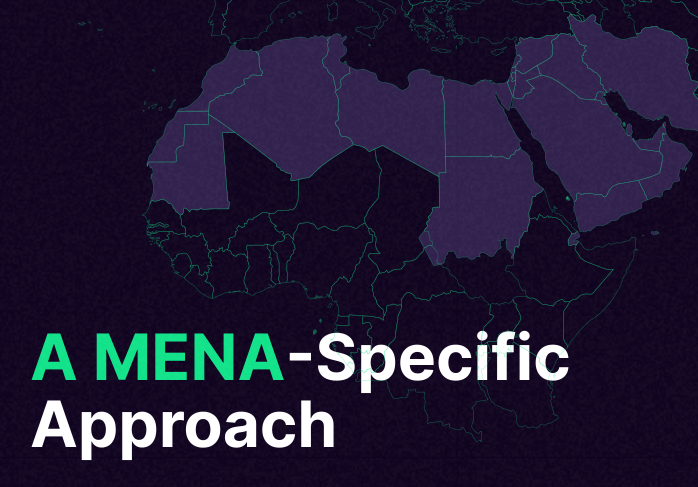
Threat Models for Arabic AI in National Projects: A MENA-Specific Approach
A comprehensive guide to threat modeling for Arabic AI in national projects. Learn how to identify and mitigate the unique security risks facing AI systems in the MENA region, from data poisoning to adversarial attacks.
Data Labeling for Sentiment Analysis in Regional Dialects
A guide to data labeling for sentiment analysis in regional Arabic dialects. Learn about the challenges of dialectal variation and best practices for building accurate datasets.
Data Cleaning and Preprocessing for MENA AI Deployments
Learn how to clean and preprocess data for AI deployments in MENA. This guide covers Arabic text challenges, regulatory compliance (UAE PDPL, KSA PDPL), morphological complexity, and quality frameworks for successful AI projects.
Annotation Tools Landscape: What Works in Arabic Content?
A comprehensive guide to the landscape of annotation tools for Arabic content, the unique linguistic challenges of annotating Arabic, and a strategic framework for selecting the right tool for your organization.
Annotation ROI: A KPI Framework for Data Leaders
A comprehensive guide for data leaders on developing a KPI framework to measure the ROI of data annotation, transforming it from a perceived cost center into a demonstrable value driver for AI initiatives.

Why Every AI Strategy Starts With Data: The Three-Pillar Framework for UAE/KSA Enterprises
Learn why data-first AI strategies outperform model-first approaches. Discover the three pillars (fidelity, coverage, lineage) and sovereign architecture for UAE/KSA enterprises.

The Arabic AI Performance Gap: Why Global Models Fail in MENA
Global AI models struggle with Arabic, creating costly performance gaps in MENA. Discover how Arabic-first AI is closing the gap and driving business impact.
Securing the Data Lifecycle: Encryption, Zero Trust, and Lineage for UAE/KSA Enterprises
Learn how to secure the data lifecycle end-to-end with encryption, Zero Trust access control, and data lineage aligned to ADGM, PDPL, SAMA, and NCA Essential Cybersecurity Controls.

Local Expertise: Why Human Context Still Matters in Arabic-First AI
Learn why human expertise remains central to Arabic-first AI readiness. Discover how dialects, code-switching, and Arabizi reshape architecture and governance for UAE/KSA enterprises under ADGM and PDPL.
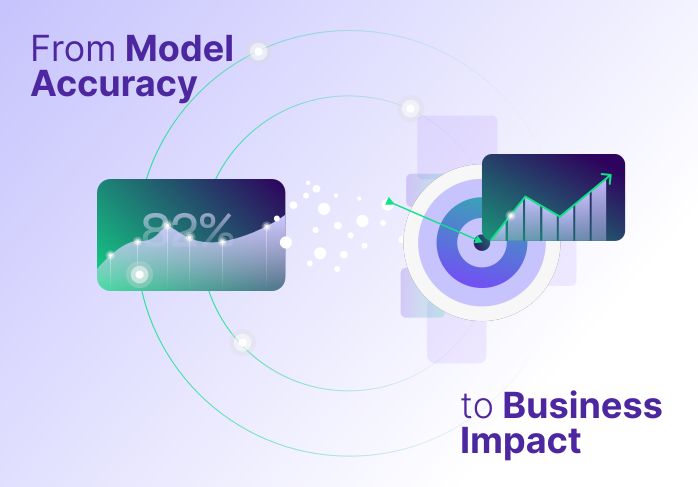
KPIs for Enterprise AI Success: From Model Accuracy to Business Impact
Learn how to build an enterprise AI KPI stack that ties model behavior to user experience, operations, and P&L. Includes SLOs, telemetry, and governance for UAE/KSA regulated environments under ADGM and PDPL.

Agentic AI —FAQ with Hilal Muhammad
How do we monitor and audit something that’s making decisions on its own? That’s the kind of question companies are asking now that agentic AI is moving from hype to real deployment. Hilal Muhammad lays out what these systems can do, where they fit, and wht it takes to run them without losing control.

Human Expertise as Infrastructure: Why Native Annotators are Non-Negotiable for High-Stakes AI
Learn why native human expertise is critical infrastructure for high-stakes AI in the UAE and KSA. Discover the six-layer "expert-in-the-loop" stack for accuracy, safety, and compliance.

AI Model Deployment: From Strategy to Operational Reality
Learn AI model deployment patterns (canary, blue-green, shadow, MAB), infrastructure (Kubernetes, Triton), and MLOps for UAE/KSA enterprises with ADGM/PDPL compliance.
How Trusted Clean Data Builds Long-Term Value for UAE and KSA Enterprises
Learn how curated, contextual, continuously verified data drives faster model updates, higher accuracy, and lower compliance risk through data contracts, lineage, and observability aligned to ADGM and PDPL.

From Collection to Context: Building Reliable Datasets for Enterprise AI
Learn how to build reliable datasets with decision-driven collection, ground truth quality, and data lineage aligned to ADGM and PDPL requirements for UAE/KSA enterprises.

From AI Mandate to Market Reality: Why Supply Chain QA is Now a Governance Issue
AI quality assurance has moved from engineering hygiene to governance necessity. Learn how supply chain QA, regulation, and AI oversight intersect across the UAE and GCC.
Enterprise Data Readiness Diagnostic: A 30-Day Assessment for UAE/KSA Organizations
Learn how to run a 30-day data readiness assessment across Quality, Governance, Accessibility, and Compliance with measurable indicators aligned to ADGM, DIFC, and KSA PDPL.

How AI is Transforming GCC Retail: From Scale to Precision
Learn how GCC retailers use AI for demand forecasting, Arabic customer service (Munsit ASR), model validation (TestAI), and conversational analytics (Clarus AI) with data sovereignty.
7 Data Annotation Best Practices for Enterprise AI
Learn data annotation best practices for enterprise AI, including Arabic NLP challenges, human-in-the-loop workflows, quality assurance, and ADGM/PDPL compliance for UAE/KSA.
AI in Insurance: Risk Assessment, Claims Processing, and Customer Experience
Learn how AI transforms insurance through risk assessment, automated claims, and fraud detection. Includes UAE/KSA Takaful context, DHA/DOH compliance, and Arabic-first implementations.

4 Key Applications of AI in Modern Banking: Risk, Experience, Operations, and Compliance
Learn how AI transforms banking through fraud detection, customer experience, operations automation, and regulatory compliance. Includes UAE/KSA case studies, ADGM/PDPL requirements, and Arabic-first implementations.
Data Sovereignty for Regulated Sectors: In-Region Control for Banks, Healthcare, and Government
Learn how banks, healthcare providers, and government agencies implement data sovereignty with in-region storage, HSM-backed encryption, and immutable audit logs aligned to ADGM and NCA requirements.
Design Your Data Strategy in Six Steps
Learn how to design a comprehensive data strategy in six steps with modern architecture, governance, self-service analytics, and continuous improvement aligned to ADGM and PDPL

Data Annotation: Building High-Quality Training Data for AI in the UAE and KSA
Learn how structured data annotation, human-in-the-loop validation, and quality assurance build reliable, compliant AI systems for enterprises in the UAE and KSA.

AI in Government: Transforming Public Service Delivery in the UAE and KSA
Discover how AI transforms government services with citizen-facing automation, predictive analytics, and transparent decision-making aligned with SDAIA, Dubai Smart City, and regional digital strategies.

Data Preparation: Turning Raw Inputs into Intelligent Assets
Learn how structured data preparation, annotation, labeling, and quality control build trustworthy, compliant AI systems for enterprises in the UAE and KSA under ISO and NIST frameworks.

Custom vs Off-the-Shelf AI: Build vs Buy for Regulated Enterprises in the UAE and KSA
Learn when to build custom AI vs buy off-the-shelf solutions. Explore RAG, fine-tuning, hybrid architectures, and governance frameworks for regulated enterprises in the UAE and KSA.
Closing the Arabic AI Gap: A Guide to Sovereign, Arabic-First AI
Learn how to close the Arabic AI gap with a sovereign, Arabic-first AI stack. A deep dive into the data, tokenization, and evaluation challenges and solutions.
Building the Arab AI Commons: A Roadmap for Regional Collaboration
Learn how regional collaboration can advance Arabic AI while respecting PDPL and data sovereignty.
Building a Data-Driven AI Roadmap: From Sourcing to Sovereignty
Learn how to build a data-driven AI roadmap from sourcing to sovereignty with lakehouse architecture, NIST AI RMF alignment, and ADGM/PDPL compliance for UAE and KSA enterprises.

Beyond the Hype: How to Navigate the AI Bubble’s Real-World Impact
A practical analysis of the AI bubble’s real-world impact on capex, power, supply chains, and enterprise risk. Includes a governance playbook for UAE and GCC organizations focused on unit economics, sovereignty, and resilience.
.svg)
Ask Hassan: Where Should Your AI Roadmap Actually Start?
Learn from Hassan Abu Sheikh (Director of Products at CNTXT) how to build practical AI roadmaps for enterprises and governments in UAE/KSA with data readiness, infrastructure, and measurable ROI.

Arabic LLMs: Regional Intelligence for MENA Enterprises
Discover how Arabic-native large language models deliver genuine regional intelligence with dialect-aware preprocessing, cultural grounding, and governance aligned to UAE/KSA regulations.

Arabic AI’s Dialect Divide: A Guide to Dialect-Aware AI
Learn about the Arabic AI dialect divide and how to build a dialect-aware AI stack. A deep dive into the data, modeling, routing, and evaluation challenges and solutions.

Arabic AI: From Translation to Understanding
Discover the shift from translation-based Arabic AI to true understanding. A guide to Arabic-first AI, dialect-aware pretraining, and production architecture.

Anatomy of High-Value Data: How Enterprises Build Reliable AI Foundations
Explore how structured governance, bilingual data quality, and in-region controls turn enterprise information into high-value, auditable assets that power trusted AI across the UAE and KSA.
AI in Telecommunications: From Network Optimization to Customer Experience
Learn how AI transforms telecommunications with intelligent network optimization, predictive maintenance, and personalized customer experiences that meet TRA, CITC, and regional 5G deployment requirements.

AI Agents vs. AI Assistants: What's the Difference and Which Does Your Business Need?
Understand the critical differences between AI agents (autonomous, goal-oriented) and AI assistants (reactive, human-in-loop) with enterprise use cases for banking, healthcare, and HR in UAE/KSA.

8 Things to Consider When Introducing AI in Healthcare: A UAE/KSA Implementation Guide
Discover 8 critical factors for introducing AI in healthcare including regulatory compliance (DHA, DOH, MOH), data quality, interoperability, and clinical workflow integration for UAE/KSA.

Custom Retrieval Systems: How Regional Banks Benefit from RAG
Discover how Retrieval-Augmented Generation (RAG) is enabling regional banks in the GCC and beyond to build custom AI solutions that rival those of global giants. Learn how RAG is transforming customer service, internal operations, and risk management.
Chatbots for Public Sector: Best Deployment Models for Arabic Service
Explore the best deployment models for Arabic-language chatbots in the public sector. This guide covers the unique challenges of Arabic NLP, the pros and cons of on-premise, cloud, and hybrid deployments, and the rise of specialized chatbot platforms for the MENA region.

Building Secure AI-Driven IoT Networks for Field Ops
As MENA enterprises deploy AI-driven IoT networks for field operations, security is a top priority. This guide explores the unique security challenges of the IoT and provides a practical roadmap for building a secure and resilient IoT network.

Building Diverse, Schema-Rich Arabic Datasets
A guide to building high-quality Arabic datasets. Learn about schema design, dialectal diversity, morphological richness, and best practices for creating schema-rich data for NLP.
Beyond Translation: A Strategic Guide to Localizing AI Interfaces for GCC Customer Habits
A strategic guide for enterprises on moving beyond simple translation to truly localize AI-driven interfaces for the unique cultural, linguistic, and behavioral habits of customers in the GCC region.

Beyond MSA: Building Language Models for GCC-Focused Applications
A strategic guide for enterprises on the challenges and best practices of developing language models tailored to the unique linguistic, cultural, and dialectal landscape of the GCC region.
Automating Compliance in Healthcare Workflows Using AI: A New Prescription for a Healthy System
Discover how AI is revolutionizing healthcare compliance in the MENA region. This guide explores the use of AI to automate complex workflows, reduce risk, and free up clinicians to focus on what matters most: patient care.
Automating Annotation: Tools and Pitfalls for CTOs
A comprehensive guide for CTOs on automating data annotation. Learn about AI-assisted tools, quality challenges, cost-benefit analysis, and best practices for scaling annotation workflows.

Automated Anomaly Detection in Smart Grid and Telecom ML
As MENA enterprises embrace the smart grid and 5G, securing these critical infrastructure systems is a top priority.
Authentication Controls for Access to High-Risk AI Models
As MENA enterprises deploy high-risk AI models, securing access to these powerful new systems is a top priority. This guide explores the critical role of authentication controls, from multi-factor authentication to adaptive, AI-driven approaches.

Privacy in the Annotation Workflow: Regulatory Compliance in MENA
Navigate UAE and Saudi Arabia data protection laws in annotation workflows. Learn privacy-preserving techniques including differential privacy, k-anonymity, and GDPR-aligned pseudonymization for MENA compliance.
Annotators as Project Stakeholders: Collaboration Strategies
Treating annotators as project stakeholders rather than task executors reduces turnover by 18-43% and improves annotation quality by 41%. Learn evidence-based collaboration strategies.
.svg)
Using Schema Design for Multi-Domain AI Readiness
Learn how to design robust annotation schemas for multi-domain AI. This guide covers ontology-based validation, hierarchical labeling, cross-domain transfer, and schema evolution strategies.

Error Analysis: Reducing Annotation Bias in Speech Datasets
Learn how to identify and reduce annotation bias in speech datasets. This guide covers bias sources, error detection methods, quality metrics, and mitigation strategies for fair ASR systems.

Enterprise Annotation Cost Modeling: Forecast vs. Reality
Learn why 91.5% of big projects exceed budgets. This guide covers annotation cost forecasting, hidden expenses, ROI calculation, and strategies to align forecasts with reality.

Endpoint Security for Speech Annotation and Field Data: A MENA-Focused Guide
A comprehensive guide to endpoint security for speech annotation and field data collection in the MENA region. Learn how to protect sensitive voice data across the entire workflow, from mobile devices in the field to annotator workstations.

End-to-End Workflow Automation for GCC Government Operations: A New Era of Public Service
Explore how GCC governments are leveraging AI and automation to build end-to-end workflows, transforming public service delivery and operational efficiency. This guide covers key use cases, challenges, and the strategic imperative behind this digital transformation.

A Blueprint for Financial Infrastructure Security in the MENA Region
Explore a comprehensive, layered approach to securing financial infrastructure in the MENA region. This guide details the critical layers of a Defense in Depth strategy, from physical and network security to data protection and incident response, aligned with regional frameworks like the SAMA Cyber Security Framework.
AI-Powered Document Processing for Legal Teams in MENA
Discover how AI-powered document processing is helping legal teams in the MENA region to tame the document deluge. This guide explores the key use cases for this technology, the rise of legal tech in the region, and the importance of Arabic NLP.
Annotation Guidelines and Checklists for Government Datasets
A guide to creating annotation guidelines and checklists for government datasets. Learn about data classification, security, and best practices for public sector data labeling.
A Framework for Building Safe and Contextually Accurate Chatbots
A comprehensive guide for enterprises on the critical challenges of building safe and contextually accurate chatbots, detailing the technical and ethical guardrails necessary for trustworthy conversational AI.

Trust but Verify: A Guide to Audit and Certification for Cross-Border AI Deployments
A guide for enterprises on navigating the complex world of audit and certification for cross-border AI systems, focusing on frameworks like SOC 2, ISO 27001, and the APEC CBPR.

The Universal Translator: A Guide to Interoperability for Arabic AI Plug-ins
A guide for enterprises on ensuring Arabic AI plug-ins are interoperable with global enterprise software like SAP and Oracle, focusing on API design, microservices, and open standards.
The Power of the Crowd: Community-Driven Annotation for Regionally Relevant AI
A strategic guide on leveraging community-driven data annotation to create AI models that are deeply relevant to the cultural and linguistic nuances of the MENA region.

How Edge Computing is Revolutionizing Regional Infrastructure Protection
Discover how edge computing is transforming the protection of critical infrastructure in the MENA region, from enhancing the security of energy grids to enabling real-time monitoring of smart cities. This article explores the benefits, applications, and security considerations of edge computing in the GCC.

The Digital Silk Road: A Guide to Data Transfer and Localization in Multi-Region Settings
A guide for enterprises on managing the complexities of data transfer and localization in a multi-region environment, focusing on legal mechanisms, architectural patterns, and data residency.
Designing MENA-Compliant APIs for AI Products
A guide for developers and architects on designing secure, compliant, and culturally aware APIs for AI products in the MENA region, covering PDPL, data residency, and API security best practices.

The Digital Fortress: A Guide to Encryption, Privacy, and SaaS in the MENA Region
A best-practice guide for SaaS providers operating in the MENA region, covering encryption strategies, privacy-by-design, and architectural patterns for complying with data residency laws.

Data Residency in the GCC: A Strategic Guide for Chief Technology Officers
An essential guide for CTOs on navigating the complex data residency and data sovereignty regulations across the GCC, with a focus on Saudi Arabia, the UAE, and Qatar.
A Unified Framework for Aligning Arabic AI with PDPL, DGA, and GDPR
A strategic framework for enterprises on achieving seamless compliance for AI systems across the complex regulatory landscapes of Saudi Arabia’s PDPL and DGA, and the EU’s GDPR.

The Anatomy of an Annotation QA Workflow
Learn how to build a robust annotation QA workflow. This guide covers the 4 stages, key roles, quality metrics (IAA, F1), and best practices for high-quality data.

The Adaptable Blueprint: Ensuring Enterprise Architecture Supports Regional AI Models
A guide for enterprise architects on designing and evolving their architecture to support regional AI models, focusing on federated architecture, data governance, and the role of the EA team as a strategic enabler.

Tailor-Fit AI Solutions: Addressing Industry-Specific Data Challenges
Move beyond one-size-fits-all AI. This guide explores the rise of vertical AI and how tailor-fit solutions are addressing the unique and complex data challenges of key industries like healthcare, finance, and manufacturing in the MENA region.

Secure Onboarding for Enterprise AI Teams: A Playbook for MENA
Discover a comprehensive framework for securely onboarding AI and ML teams in the MENA region, covering role-based access control (RBAC), secure MLOps pipelines, and fostering a security-first culture to protect your most valuable digital assets.
Secure Deployment Playbooks: A DevSecOps Template for MENA Enterprises
A practical guide to creating and using secure deployment playbooks for enterprises in the MENA region. This article provides a template and best practices for integrating security into your deployment process and building a more resilient DevSecOps culture.

Scaling Annotation in Healthcare: Lessons from Clinical NLP
Learn how to scale annotation workflows for clinical NLP. Discover evidence-based strategies for maintaining quality, managing complexity, and building gold standard datasets in healthcare AI.

Resilience Against Adversarial Attacks in AI Applications
Explore the landscape of adversarial AI attacks, from evasion and poisoning to model inversion. This guide details robust defense strategies like adversarial training, defensive distillation, and Byzantine-robust aggregation, providing a playbook for MENA enterprises to secure their AI deployments.
Real-Time Security Dashboards for Operational Teams: A MENA Perspective
Discover the best practices for designing and implementing real-time security dashboards for operational teams in the MENA region. This guide covers the key metrics, KPIs, and design principles for building a dashboard that provides a clear and actionable view of your organization's security posture.

Pitfalls in Global-to-Local Model Migration: A MENA-Focused Guide
A comprehensive guide to the challenges and pitfalls of migrating global AI models to the local context of the MENA region. Learn how to avoid common mistakes in data, language, culture, and compliance.

Privileged Access Monitoring for Sovereign Data: A MENA Imperative
Explore the critical role of Privileged Access Management (PAM) in ensuring data sovereignty in the MENA region. This guide details the best practices for monitoring and controlling privileged access to sensitive sovereign data, aligned with regional data protection laws.

One App, Many Markets: A Guide to Arabic AI Cross-Market Integration
A strategic guide for enterprises on integrating Arabic AI applications across diverse MENA markets, addressing the dual challenges of dialectal variation and regulatory compliance.
Network Segmentation: Defining Secure Data Boundaries for AI
As AI adoption accelerates in the MENA region, securing the data that fuels these powerful new systems is a top priority. This guide explores the critical role of network segmentation in defining secure data boundaries for AI and provides a practical roadmap for implementation.

Network Isolation Best Practices for Regulated Sectors: A MENA Perspective
Explore the critical role of network isolation and segmentation in meeting compliance requirements for regulated sectors in the MENA region, including finance and healthcare. This guide details best practices for building a secure and compliant network architecture.
Multi-Step Agentic Workflows: Platinum Use Cases in Finance and Media
Explore the transformative power of multi-step agentic workflows. This guide delves into the platinum use cases for agentic AI in finance and media, from autonomous portfolio management to hyper-personalized content creation.

Multi-Cloud Monitoring: The Rise of GCC Specialty Platforms
A deep dive into multi-cloud monitoring in the GCC, exploring how local managed service providers are becoming the de facto specialty platforms for navigating data sovereignty, compliance, and the complexities of hybrid environments.

Monitoring Model and Data Access: What Regulators Look For
Understand what regulators in the MENA region and globally look for when it comes to monitoring AI models and data access. This guide covers the key principles of AI governance, the importance of audit trails, and the technologies that can help you build a compliant monitoring strategy.
Monitoring and SIEM Integration in Data Pipeline Operations
As data pipelines become the central nervous system of the modern enterprise, securing them is a top priority. This guide explores the critical role of monitoring and SIEM integration in protecting your data pipelines and ensuring the integrity of your data.
Model Performance vs. Annotation Depth: What Matters Most?
Discover how annotation depth impacts AI model performance. This evidence-based guide covers fine-grained vs. coarse annotations, the quantity-quality tradeoff, cost optimization, and when to invest in detailed labels for NLP, computer vision, and healthcare AI.

Minimizing Inter-Annotator Disagreement in Complex Projects
A guide to minimizing inter-annotator disagreement in complex annotation projects. Learn about the causes of disagreement, how to measure it, and strategies for improving consistency.

Hybrid and Multi-Cloud Deployments for Arabic AI
A strategic guide for enterprises on designing and implementing effective hybrid and multi-cloud architectures for Arabic AI, balancing performance, cost, and data sovereignty.
Isolation of Workloads: Cloud vs. On-Prem Security Models
As MENA enterprises embrace the cloud, the debate over the best security model for workload isolation is heating up. This guide provides a comparative analysis of cloud and on-premise security models, helping you to choose the right approach for your organization.

Integrating AI Domain Models with Legacy Enterprise Software: A Bridge to the Future
Unlock the value of your legacy enterprise software by integrating it with modern AI domain models. This guide provides a practical roadmap for overcoming the challenges of integration and building a bridge to a more intelligent and automated future.

Inclusive AI: A Framework for Bias Mitigation in the MENA Region
A strategic guide for enterprises on identifying and mitigating bias in AI systems, ensuring fairness, inclusivity, and trust for the diverse populations of the Middle East and North Africa.
Identity Management: Role-Based Access for Regulated Enterprises
For regulated enterprises in the MENA region, identity and access management is a critical business function. This guide explores the power of Role-Based Access Control (RBAC) to improve security, to simplify compliance, and to enable digital transformation.
From Local Models to Global Impact: Architecting Arabic AI for Scale
A strategic guide for enterprises on the architectural and hosting decisions required to build and deploy Arabic AI applications for a global audience, addressing challenges from data strategy to compliance.




































.jpeg)
.jpeg)