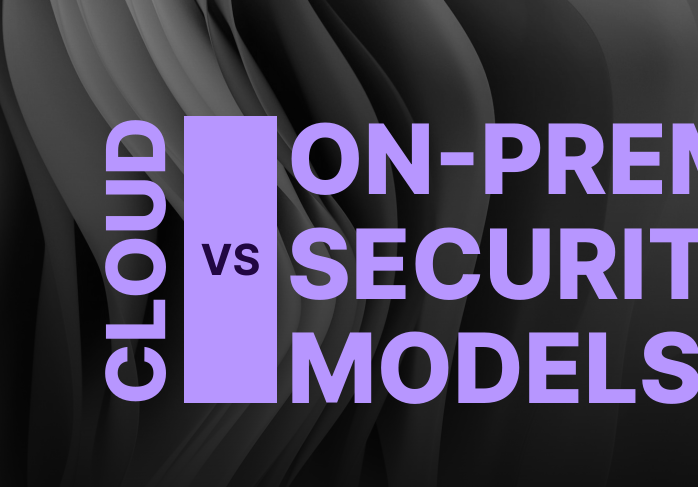
Isolation of Workloads: Cloud vs. On-Prem Security Models
Isolation of Workloads: Cloud vs. On-Prem Security Models


Powering the Future with AI
Key Takeaways

Workload isolation reduces breach impact by containing attacks within a single service and blocking lateral movement across systems
On-premise security models provide deep control and visibility, but they introduce high operational cost, scaling friction, and slow response to change
Cloud security models enforce isolation through Zero Trust controls that assume compromise and verify every access path by default
Hybrid isolation models balance regulatory control with cloud scalability, allowing sensitive workloads to remain local while less critical services scale elastically
The ability to contain a threat is just as important as the ability to prevent it. This is the principle behind workload isolation, a security best practice that is becoming increasingly critical in today’s hostile cyber threat landscape.
A workload is a discrete unit of work, such as a web server, a database, or a microservice. By isolating workloads from each other, you can create a series of digital bulkheads within your network, limiting the blast radius of a security breach. If one workload is compromised, the attacker will not be able to move laterally to other workloads. This is a fundamental principle of modern cloud workload security.
For enterprises in the Middle East and North Africa (MENA) region, the question of how to best achieve workload isolation is a complex one. It is a question that goes to the heart of the debate over cloud vs. on-premise security models.
Should you build your own digital fortress, with complete control over your infrastructure and your security? Or should you embrace the scalability and flexibility of the cloud, and entrust your security to a third-party provider?.
The On-Premise Security Model: The Castle and the Moat
The traditional, on-premise security model is based on the concept of a perimeter. The idea is to build a strong digital fortress around the organization’s network, with firewalls, intrusion detection systems, and other security controls at the perimeter. Within the fortress, workloads are often not well-isolated from each other. This is the “castle and moat” approach to security.
The Pros of On-Premise Workload Isolation
- Granular Control: With an on-premise security model, you have complete control over your infrastructure and your security. You can implement any security controls you want, and you are not limited by the capabilities of a third-party cloud provider.
- Deep Visibility: With an on-premise security model, you have complete visibility into your network traffic. This can make it easier to detect and respond to security threats.
- Data Residency: For organizations in the MENA region with strict data sovereignty requirements, an on-premise model can provide the assurance that their data will never leave the country.
The Cons of On-Premise Workload Isolation
- High Cost: An on-premise security model can be very expensive to implement and to maintain. You need to purchase and to manage your own hardware and software, and you need to hire a team of skilled IT professionals to manage the system.
- Crippling Complexity: An on-premise security model can be very complex to manage. It can be difficult to keep track of all of the different security controls and to ensure that they are all working together effectively.
- Limited Scalability: An on-premise security model can be difficult to scale. If you need to add new workloads, you may need to purchase and to configure new hardware and software.
The Cloud Security Model: The Zero Trust Approach
The cloud security model is based on a fundamentally different philosophy: Zero Trust. The idea is that you cannot trust any user or device, whether they are inside or outside the network. Every request to access a resource must be authenticated and authorized. Workloads are isolated from each other by default, and they are only allowed to communicate with each other if there is an explicit policy that allows it. This is a much more granular and dynamic approach to security, and it is well-suited to the distributed and ephemeral nature of modern cloud applications.
The Pros of Cloud Workload Isolation
- Effortless Scalability: The cloud is designed for scalability. You can easily add new workloads as needed, and you only pay for the resources you use.
- Simplified Management: The cloud can be much simpler to manage than an on-premise security model. The cloud provider takes care of all of the underlying infrastructure, so you can focus on your applications.
- Cost-Effectiveness: The cloud can be much more cost-effective than an on-premise security model. You do not need to purchase and to manage your own hardware and software, and you do not need to hire a large team of IT professionals.
The Cons of Cloud Workload Isolation
- Shared Responsibility: With a cloud security model, you are entering into a shared responsibility model with the cloud provider. You are responsible for securing your applications and your data, while the cloud provider is responsible for securing the underlying infrastructure. It is critical to understand where the line of responsibility is drawn.
- Reduced Visibility: With a cloud security model, you may have less visibility into your network traffic. This can make it more difficult to detect and respond to security threats. However, cloud providers are increasingly offering tools and services to improve visibility and to provide more granular control.
The Hybrid Model: A Pragmatic Approach for a Complex World
For many MENA enterprises, the answer to the cloud vs. on-premise debate is not an either/or proposition. A hybrid security model, which combines the best of both worlds, is often the most effective strategy.
In a hybrid model, you can run some of your workloads on-premise and some of your workloads in the cloud. This allows you to take advantage of the control and visibility of an on-premise security model for your most sensitive workloads, while also leveraging the scalability and cost-effectiveness of the cloud for your less sensitive workloads.
Building better AI systems takes the right approach

Choosing the Right Path for Your Organization
The choice between a cloud, on-premise, or hybrid security model is a strategic one. There is no single right answer. The best approach for your organization will depend on a careful consideration of a wide range of factors, including your security requirements, your budget, your technical expertise, and the unique regulatory and threat landscape of the MENA region. By taking a thoughtful and strategic approach to workload isolation, you can build a security architecture that is not only resilient and secure but also agile and cost-effective, providing a solid foundation for your organization’s digital transformation journey.
FAQ
Powering the Future with AI

































.svg)











.svg)