Data Annotation: Building High-Quality Training Data for AI in the UAE and KSA


Powering the Future with AI
Key Takeaways

Annotation determines AI reliability. Clear labels, consistent guidelines, and review loops directly shape model accuracy and predictability.

Arabic data requires regional expertise. Dialects, code-switching, and cultural context demand native annotators and purpose-built tooling.

Human oversight remains essential. Human-in-the-loop validation and consensus scoring prevent context loss and silent labeling errors.

Governance turns annotation into an asset. Traceability, versioning, and PDPL-aligned controls make training data auditable and reusable.
Data annotation is the structured process of labeling datasets, such as images, audio, text, or video, so machine learning models can recognize patterns and make accurate predictions.
A model trained to detect fraudulent transactions, for instance, can only learn if historical records are accurately labeled as "fraudulent" or "legitimate." The clearer and more consistent the annotations, the more reliable the resulting AI system.
In enterprise environments, where accuracy and accountability matter as much as performance, annotation becomes a strategic process, combining human expertise, standardized workflows, and automated tools.
How Data Annotation Works
Annotation sits in the early stages of the AI development pipeline. It begins with data collection, followed by data cleaning and structuring. The annotation phase introduces human or machine-generated labels to give meaning to the data.
The Workflow
The annotation workflow typically includes:
1. Guideline Creation: Subject matter experts define labeling standards and class definitions. Clear guidelines reduce ambiguity and improve inter-annotator agreement.
2. Tool Selection: Specialized platforms support annotation across modalities: text, image, audio, or video. Tools must support Arabic right-to-left text, bilingual interfaces, and regional compliance requirements.
3. Human-in-the-Loop (HITL): Human annotators label or verify machine-labeled data to ensure accuracy. HITL is essential for context-heavy workflows where language nuance, domain specificity, and safety constraints expose gaps that automated testing misses.
4. Quality Assurance: A multi-tier review process evaluates consistency, coverage, and precision before datasets are fed into model training.
This interaction between humans and machines is essential. Automation accelerates labeling, but humans provide context and nuance, especially in complex domains like sentiment analysis or medical imaging.
Fundamental Types of Data Annotation
Data annotation encompasses multiple methodologies tailored to specific data types and machine learning objectives. Each annotation type serves distinct purposes in training algorithms to recognize patterns, classify information, or predict outcomes.
Image Annotation
Image annotation involves adding labels, boundaries, or metadata to visual content to train computer vision models. This process helps machines to identify objects, understand spatial relationships, and interpret visual scenes with human-level accuracy.
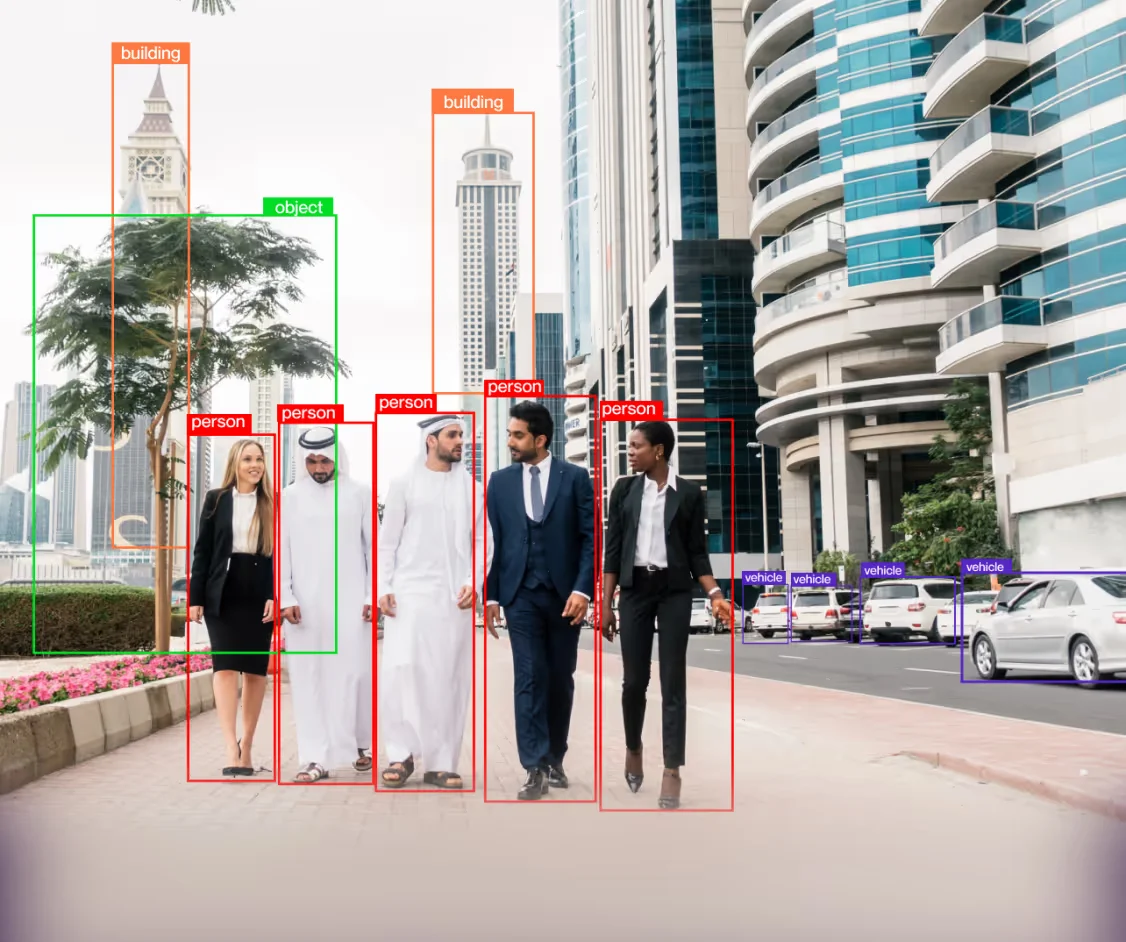
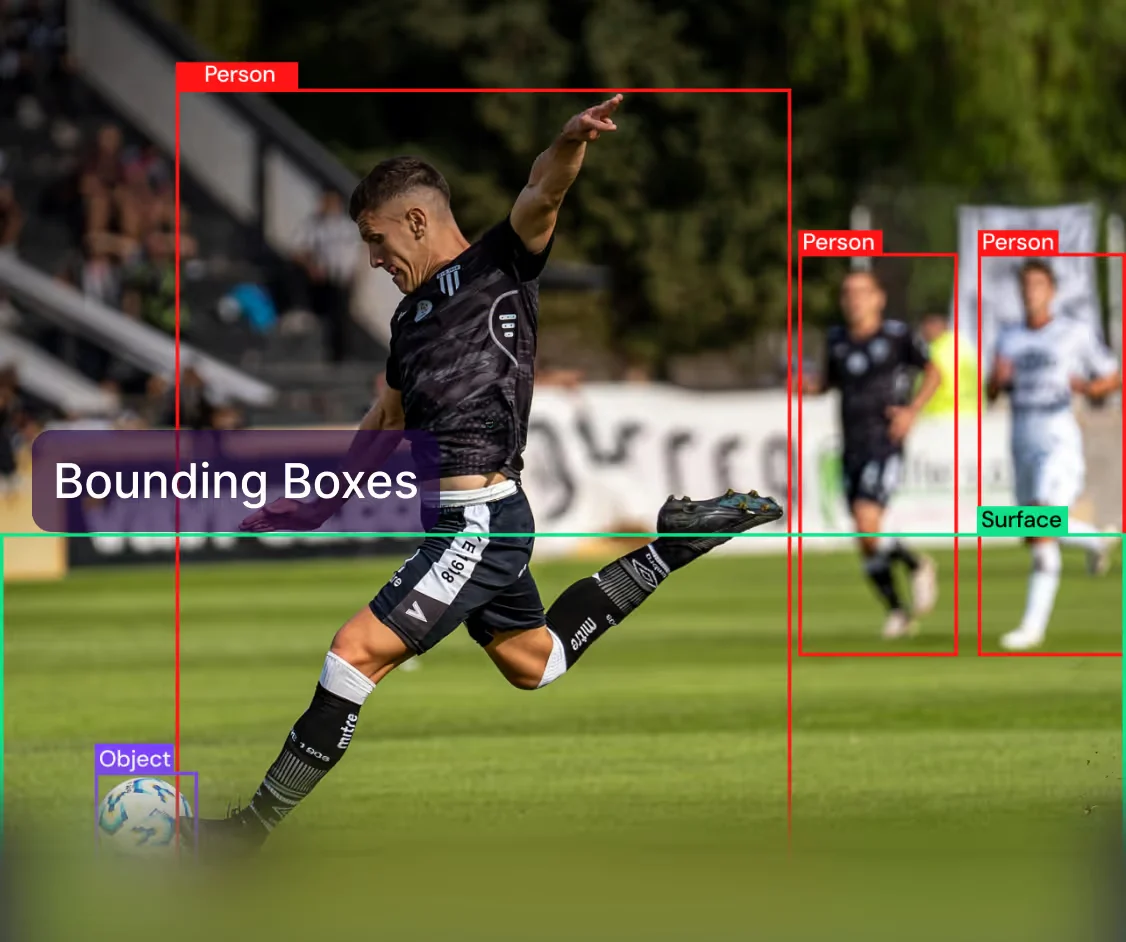
- Bounding Box Annotation represents the most common form of image labeling. Annotators draw rectangular boxes around objects of interest within images, creating precise boundaries that define object locations. Each bounding box receives a class label identifying the object type.
For autonomous vehicle development, annotators create bounding boxes around cars, pedestrians, traffic signs, and road markings. The resulting dataset trains object detection models to identify and locate these elements in real-time driving scenarios.
- Polygon Annotation provides more precise object boundaries than bounding boxes by allowing annotators to trace irregular shapes. This method proves essential for applications requiring exact object boundaries, such as medical imaging where tumor boundaries must be precisely defined, or satellite imagery analysis where building footprints need accurate delineation.
- Semantic Segmentation assigns class labels to every pixel in an image, creating detailed maps of object boundaries and classifications. This pixel-level annotation enables models to understand scene composition at the finest granular level. Medical imaging applications use semantic segmentation to identify different tissue types, organs, or pathological regions within diagnostic scans.
- Instance Segmentation combines object detection with semantic segmentation, identifying individual object instances while providing pixel-level boundaries. This approach distinguishes between multiple objects of the same class within a single image. For example, in crowd analysis applications, instance segmentation identifies each individual person rather than treating all people as a single semantic class.
Text Annotation
Text annotation involves labeling textual data to train natural language processing models for various tasks including sentiment analysis, named entity recognition, and machine translation.
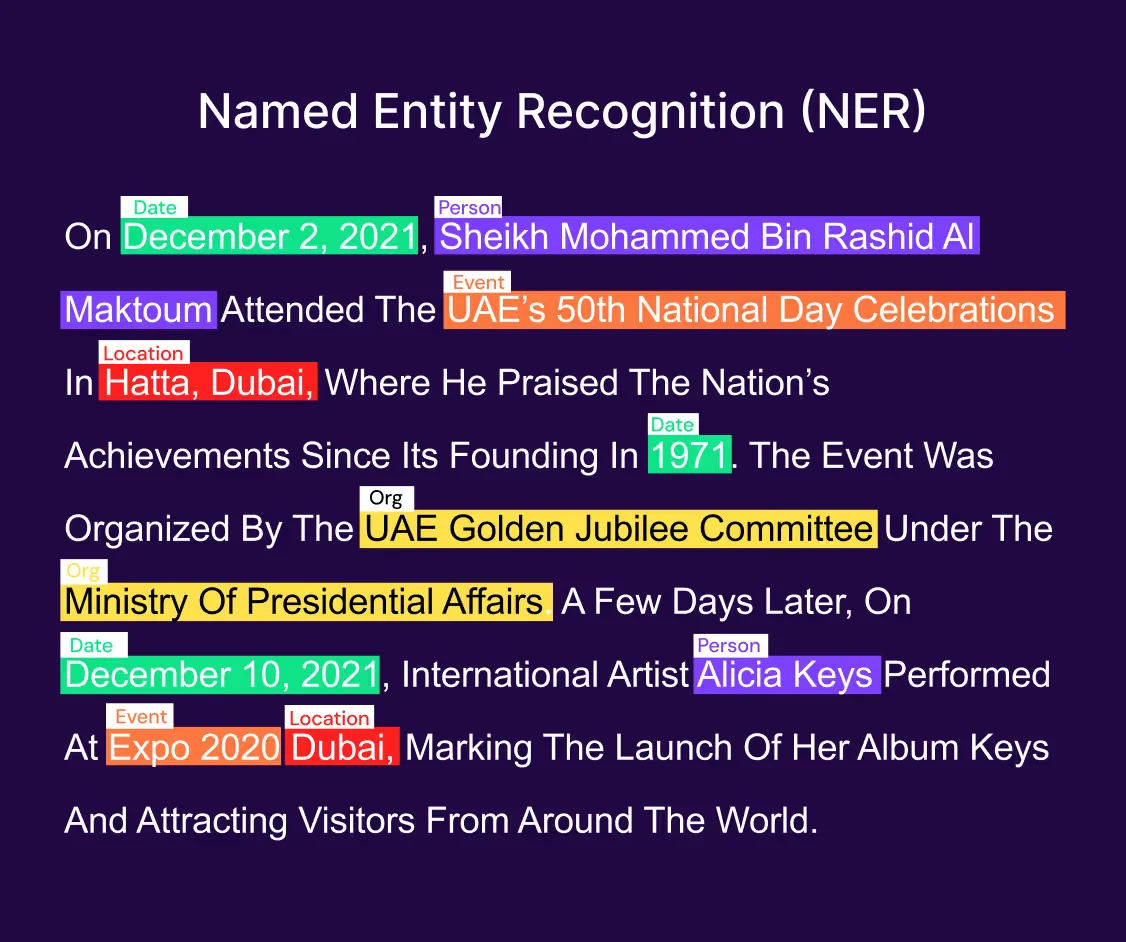
- Named Entity Recognition (NER) annotation identifies and classifies specific entities within text, such as person names, organizations, locations, dates, and monetary values. Annotators highlight relevant text spans and assign appropriate entity categories.
Financial institutions use NER annotation to extract key information from documents, identifying company names, financial figures, and regulatory references in earnings reports or compliance documents.
Regional Challenge: Arabic NER presents unique challenges including:
- Morphological Complexity: Arabic words can have multiple forms based on gender, number, and case
- Dialect Variation: Gulf, Levantine, Egyptian, and Maghrebi dialects use different vocabulary and grammar
- Right-to-Left Text: Annotation tools must support bidirectional text and mixed Arabic-English content
- Diacritics: Presence or absence of diacritical marks affects meaning and entity recognition
- Sentiment Analysis annotation assigns emotional or opinion labels to text segments, typically categorizing content as positive, negative, or neutral. More sophisticated sentiment annotation includes fine-grained emotional categories such as anger, joy, fear, or surprise.
Social media monitoring applications rely on sentiment-annotated datasets to train models that analyze public opinion about brands, products, or political topics.
- Part-of-Speech (POS) Tagging involves labeling each word in a sentence with its grammatical role, such as noun, verb, adjective, or adverb. This linguistic annotation enables models to understand sentence structure and grammatical relationships. Machine translation systems use POS-tagged data to maintain grammatical accuracy when converting text between languages.
- Dependency Parsing annotation maps syntactic relationships between words in sentences, creating tree structures that represent grammatical dependencies. This annotation type enables models to understand complex sentence structures and relationships between different sentence components.
Audio Annotation
Audio annotation involves labeling sound recordings to train models for speech recognition, audio classification, and sound analysis applications.
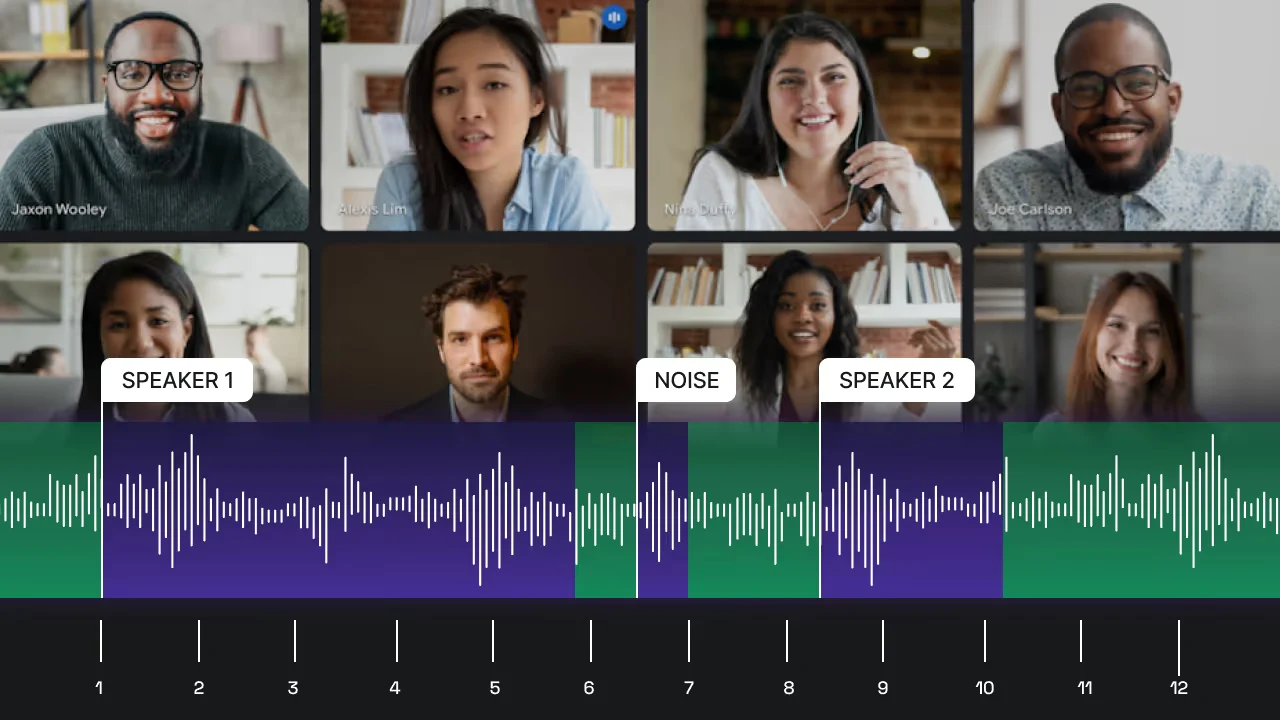
- Speech Transcription converts spoken language into written text, creating datasets for automatic speech recognition systems. Annotators listen to audio recordings and produce accurate transcripts, including punctuation, speaker identification, and temporal markers.
Voice assistant technologies rely on transcribed speech data to train models that convert spoken commands into actionable instructions.
Regional Challenge: Arabic speech transcription faces:
- Dialect Diversity: Gulf Arabic differs significantly from Levantine, Egyptian, and Maghrebi dialects
- Code-Switching: Speakers frequently mix Arabic and English within the same conversation
- Phonetic Complexity: Arabic has sounds not present in English (e.g., ع, ح, خ, غ)
- Colloquial vs. Modern Standard Arabic (MSA): Spoken dialects differ from formal written Arabic
- Speaker Identification annotation labels audio segments with speaker identities, enabling models to distinguish between different voices in multi-speaker recordings. Conference call analysis systems use speaker-identified datasets to attribute statements to specific participants and track conversation dynamics.
- Audio Event Detection involves labeling specific sounds or events within audio recordings, such as music genres, environmental sounds, or mechanical noises. Industrial monitoring applications use audio event annotation to train models that detect equipment malfunctions or safety hazards based on acoustic signatures.
Video Annotation
Video annotation combines temporal and spatial labeling to train models for video analysis, action recognition, and motion tracking applications.
- Object Tracking annotation follows objects across video frames, maintaining consistent identity labels as objects move through scenes. Autonomous vehicle systems use object tracking annotation to train models that monitor pedestrian and vehicle movements over time, predicting future positions and potential collision risks.
- Action Recognition annotation labels human activities or behaviors within video sequences, identifying actions such as walking, running, sitting, or specific gestures. Security surveillance systems employ action recognition models trained on annotated video data to detect suspicious behaviors or safety violations.
- Temporal Segmentation divides video content into meaningful segments based on scene changes, activities, or events. Sports analytics applications use temporal segmentation to identify specific plays, player actions, or game events within broadcast footage.
Why Annotation Quality Matters
The relationship between data quality and AI performance is linear. Poorly annotated data propagates bias, error, and unpredictability. High-quality annotation, by contrast, provides what AI engineers call "ground truth"—a benchmark against which the model's predictions are evaluated.
In regulated industries, annotation quality is also tied to compliance. A mislabeled medical image or misclassified transaction could lead to reputational and financial damage.
Common Challenges in Enterprise Data Annotation
Even with clear frameworks, enterprises face recurring obstacles:
- Scale: Large datasets require thousands of annotations per hour, testing both human capacity and platform efficiency.
- Consistency: Multiple annotators can interpret the same data differently without strong guidelines or QA loops.
- Cost: Skilled human annotation is expensive, especially in specialized domains like medical imaging or legal document review.
- Bias: Annotators may unintentionally reinforce social or cultural biases that influence downstream model behavior.
- Data Privacy: Annotating sensitive data such as medical or financial records requires strict anonymization and secure environments.
Regional Challenges in the UAE and KSA
- Arabic Dialect Diversity: Gulf, Levantine, Egyptian, and Maghrebi dialects require separate annotation guidelines and native speakers.
- Bilingual Operations: Enterprises must support both Arabic and English with equal quality, requiring bilingual annotators and tools.
- Compliance Requirements: UAE PDPL and Saudi PDPL mandate data protection, requiring secure annotation environments and audit trails.
- Cultural Context: Sentiment analysis and content moderation require cultural awareness to avoid misclassification of region-specific expressions.
Building better AI systems takes the right approach
Best Practices for Effective Data Annotation
Successful enterprise AI programs treat annotation as a continuous lifecycle, not a one-time project. The following practices are widely adopted across mature organizations:
1. Define Annotation Goals Early
Identify exactly what you want the model to learn. The more precise the labeling schema, the easier it is to maintain quality.
2. Build Detailed Labeling Guidelines
Create examples and edge cases. Use visual references to clarify ambiguities and standardize decision-making across annotators. For Arabic annotation, include dialect-specific examples and code-switching scenarios.
3. Adopt Human-in-the-Loop Validation
Combine automated pre-labeling with human review to balance speed and accuracy. Humans catch context errors machines can't, especially in Arabic where diacritics and context change meaning.
4. Use Consensus Scoring
Measure inter-annotator agreement. When multiple labelers consistently agree, confidence in data quality increases. For subjective tasks like sentiment analysis, require 3+ annotators per sample.
5. Implement Layered Quality Assurance
Use both random sampling and targeted audits to verify data integrity before it enters training pipelines. Audit high-stakes labels (e.g., medical diagnoses, fraud detection) with domain experts.
6. Leverage Transfer Learning and Active Learning
Use pretrained models to bootstrap annotation, and active learning loops to focus human effort on the most uncertain data. This reduces annotation cost while improving model performance.
7. Ensure Data Governance and Traceability
Track versioning, labeling history, and reviewer metadata for compliance and reproducibility. Maintain audit trails showing who labeled what, when, and under which guidelines.
Emerging Trends in Annotation
Enterprises are moving toward programmatic and synthetic annotation, where algorithms generate or infer labels from preexisting data. This reduces manual effort and accelerates scaling, but it also introduces new dependencies on model accuracy and dataset diversity.
Hybrid models, where synthetic labels are validated through human-in-the-loop review, are becoming the gold standard.
Meanwhile, annotation analytics is emerging as its own subfield: measuring annotation throughput, consensus rates, and cost efficiency as KPIs for AI readiness.
Synthetic Data Generation
Advanced AI models increasingly generate synthetic training data that reduces dependence on manual annotation. Generative adversarial networks create realistic images with known labels, while language models produce diverse text samples for NLP training. Synthetic data generation enables rapid dataset creation for new domains while addressing privacy and data availability constraints.
Foundation Models and Transfer Learning
Large pre-trained models reduce annotation requirements for specific applications through transfer learning approaches. Foundation models trained on massive unlabeled datasets can be fine-tuned with relatively small annotated datasets for specialized tasks. This paradigm shift reduces the annotation burden for many applications while maintaining high performance standards.
Automated Quality Assessment
Machine learning systems increasingly assess annotation quality automatically, identifying inconsistencies, errors, and biases without human review. These systems analyze annotation patterns, compare against statistical baselines, and flag problematic data points for expert review. Automated quality assessment enables larger-scale annotation projects while maintaining quality standards.
Use Cases Across Industries
Healthcare: Annotated radiology images train diagnostic models that detect early signs of disease. In the UAE, Dubai Health Authority (DHA) and Department of Health Abu Dhabi (DOH) require annotation to comply with medical device regulations.
Financial Services: Properly labeled transaction data enables fraud detection, anti-money laundering (AML), and risk modeling. SAMA and UAE Central Bank mandate explainable AI for credit decisions.
Manufacturing: Annotated sensor data helps predict machine failures and reduce downtime.
Retail and E-Commerce: Image and text annotations refine product recommendations and search accuracy. Arabic product descriptions require dialect-aware annotation.
Government and Smart Cities: Annotated imagery supports urban planning, surveillance, and infrastructure monitoring in Dubai Smart City and NEOM.
FAQ
Because models inherit both strengths and weaknesses from labeled data. Errors at the annotation stage propagate into production systems and are difficult to correct later.
Arabic dialect variation, bilingual data flows, and strict data protection rules require in-region teams, secure environments, and localized guidelines.
Automation works best for high-volume, low-ambiguity cases. Context-heavy data should always pass through human review to maintain accuracy.
Through inter-annotator agreement, targeted audits, and traceable review history tied to specific guidelines and data versions.
PDPL requires controlled access, data residency, audit trails, and protection of sensitive identifiers throughout the annotation lifecycle.