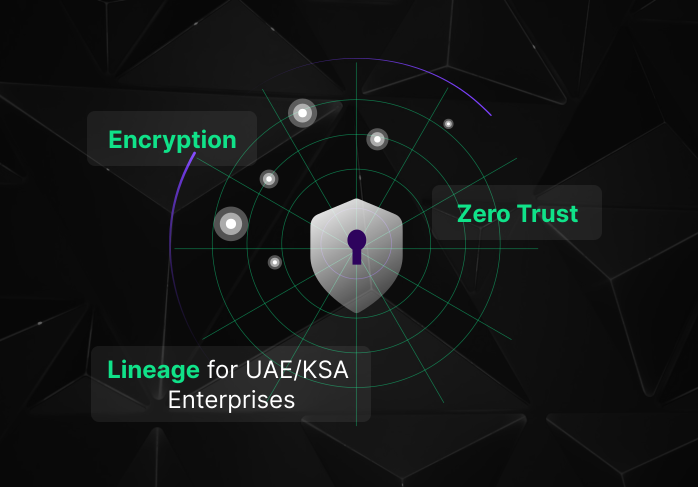
Securing the Data Lifecycle: Encryption, Zero Trust, and Lineage for UAE/KSA Enterprises
Securing the Data Lifecycle: Encryption, Zero Trust, and Lineage for UAE/KSA Enterprises


Powering the Future with AI
Key Takeaways

The perimeter is dead. You cannot protect data by building a wall around it. You must protect the data itself, wherever it goes—from ingestion to archive.
Identity is the new firewall. In a world of APIs and cloud services, the only thing that matters is who is accessing the data and why.
Compliance is not security. Checking a box for SAMA or ADGM doesn't mean you are safe. Real security requires engineering controls that are baked into your pipelines, not pasted on top.
We are building data estates that are too complex to secure.
We ingest data from dozens of sources. We transform it across multiple clouds. We feed it into real-time dashboards, API endpoints, and machine learning models. We have built a machine that generates value at incredible speed.
But we have also built a machine with a massive blast radius.
Every time we copy a table, every time we grant a permission, every time we open an API, we are increasing our exposure. And when things go wrong, the cost is catastrophic. IBM's 2023 Cost of a Data Breach Report pegs the average breach at $4.45 million.
But the money isn't the scary part. The scary part is that most organizations don't even know they've been breached until it's too late. Verizon's 2023 Data Breach Investigations Report (DBIR) shows that the vast majority of breaches are caused by credential misuse.
The attackers aren't breaking in. They are logging in.
The Illusion of Control
For years, we have tried to solve this problem with more tools. We buy more firewalls, more scanners, more dashboards. But the fundamental problem remains: we are trying to secure the infrastructure instead of securing the data.
This is a losing battle.
To win, we need a fundamental shift in mindset. We need to move from "perimeter security" to "lifecycle security." We need to protect the data itself, every step of the way.
The Three Pillars of Lifecycle Security
This isn't theoretical. This is a field-tested architecture that aligns with the strictest regulations in the region, including ADGM Data Protection Regulations, the UAE PDPL, and the NCA Essential Cybersecurity Controls.
It rests on three pillars:
1. Encrypt Everything (Really, Everything)
Encryption is often treated as a checkbox. "Yes, the disk is encrypted." That is not enough.
- At Rest: Use AES-256 with keys managed in a Hardware Security Module (HSM). Keep the keys separate from the data. If an attacker steals the drive but doesn't have the key, they have nothing.
- In Transit: Use TLS 1.2+ everywhere. Not just for external traffic, but for service-to-service communication inside your network.
- In Use: This is the new frontier. Use Confidential Computing environments that keep data encrypted even while it is being processed in memory.
2. Zero Trust: Identity is the Only Perimeter
Stop trusting IP addresses. Stop trusting "internal" networks. Trust nothing. Verify everything.
- Authentication: Passwords are dead. Use FIDO2 hardware keys for admins and service owners. If you can be phished, you will be phished.
- Authorization: Move beyond simple roles. Use Attribute-Based Access Control (ABAC). Can this user access this data right now, from this location, for this purpose?
- Secrets Hygiene: Never, ever hardcode secrets. Use workload identities that are issued at runtime and rotate automatically.
3. Lineage: Know Your Data's Story
If you don't know where your data came from, you can't trust it. And if you don't know where it's going, you can't secure it.
You need a metadata-first model that tracks every transformation. Who touched this table?
What script modified this column? Why was this record deleted?
This is for survival. When a regulator asks for an audit trail, you don't want to be digging through log files. You want to show them a graph.
Defining the Problem
Every hop increases exposure.
Files arrive from partners, APIs stream events, and internal systems replicate tables. Copies proliferate in data lakes, warehouses, feature stores, and caches.
Rapid delivery can spawn:
- Permission sprawl
- Inconsistent encryption
- Weak data lineage
Turning small oversights into systemic risk.
Bilingual Operations Add Complexity
In bilingual operations (Arabic and English), entity extraction and classification often lag, leaving sensitive fields mislabeled.
Compliance Complexity Compounds
Under:
- ADGM Data Protection Regulations
- UAE PDPL
- KSA PDPL
- Sector rules such as SAMA and NCA Essential Cybersecurity Controls
Approach: A Control Fabric That Follows the Data
The durable pattern has three strands:
- Encrypt by default
- Bind access to identity and purpose—not location
- Record lineage and events to explain who touched what, when, and why
These are engineering choices that simplify audits, limit lateral movement, and make rollback feasible when a model or dashboard goes wrong—core goals of data lifecycle security.
Encryption: Protect Data at Rest, in Transit, and in Use
At Rest: AES-256 with KMS/HSM
Use strong, validated algorithms (AES-256):
- Keep keys in KMS or HSM, never in code or configs
- Follow NIST SP 800-57 for key lifecycles, dual control, and separation of duties
In practice:
- Central key custodians
- Risk-based rotation
- Two-person approval for access
In Transit: TLS 1.2+ Everywhere
Use mutual TLS for service-to-service:
- Pin certificates where feasible
- Treat certificate lifecycle as code with automated rotation and revocation tests
In Use: Confidential Computing
Plan for confidential computing where sensitivity demands it:
- Trusted execution environments provide isolated memory and remote attestation
- Unlocking use cases where decryption on shared hosts is not acceptable

Key management discipline is the difference between crypto as a checkbox and crypto as a control. We require application teams to request keys through a service, never directly, and we test revocation as a first-class scenario during go-live.
Identity-Centric Access Control (Zero Trust)
Authentication: Phishing-Resistant MFA
Use FIDO2 for admins and service owners:
- Device posture checks for privileged sessions
- Hardware-bound authentication tokens
Authorization: RBAC + ABAC
Start with Role-Based Access Control (RBAC):
- Extend with Attribute-Based Access Control (ABAC) so policies consider:
- Data sensitivity
- User location
- Time
- Purpose
Issue time-bound, just-in-time access:
- Elevated roles with session recording
- Break-glass workflows for emergencies
Secrets Hygiene
Remove secrets from code, drives, and chat:
- Use workload identities (OIDC tokens) issued at runtime
- Store static secrets in a vault and rotate automatically
Policy as Code
Map NIST SP 800-53 access and audit controls into policy definitions:
- Test them like application code
- Continuously evaluate drift and alert on anomalous queries to reduce blast radius during compromise
Policy as code turns auditor questions into executable checks. Our pipelines fail fast when data leaves an allow list, when a permission is broader than the policy, or when a model pulls unapproved features. The point is to catch issues before they reach production.
Building better AI systems takes the right approach

Lineage and Observability: Explain Every Transformation
Metadata-First Model
Catalog datasets, owners, schemas, and sensitivity labels:
- Track every transformation and join
- Version data, code, and configuration for reproducibility
Immutable Logs
Maintain immutable logs that tie access events to specific assets and stated purposes:
- What regulators expect under ISO/IEC 27001 and GDPR Article 32
- Accelerates recovery by isolating faulty data, estimating blast radius, and replaying jobs with corrected inputs
Architecture: A Secure Path from Source to Deployment
Detailed Stage Breakdown
Ingest:
- Validate against schemas
- Auto-classify on arrival
- Encrypt before persistence
- Block unknown sources by default
Store:
- Segment by sensitivity (separate accounts/projects)
- Encrypt with KMS/HSM-managed keys
- Enforce retention aligned to legal obligations
Process:
- Run in isolated environments with least privilege
- Apply masking/tokenization to reduce direct identifier exposure in analytics and non-prod
Train and Develop:
- Require approved datasets
- Capture feature and model lineage
- Run ethics and fairness reviews where models affect people
- Document intended use
Deploy and Serve:
- Gate releases with signed artifacts and provenance checks
- Enforce runtime policy, secrets hygiene, mTLS, and egress controls
Archive or Dispose:
- Apply retention schedules
- Track legal holds
- Sanitize media per NIST SP 800-88
A Secure Path from Source to Deployment
Here is what this looks like in practice:
The Regional Reality: Bilingual and Sovereign
In the UAE and KSA, we have unique challenges.
•Bilingual Data: Our data is a mix of Arabic and English. Standard tools often fail to classify Arabic PII correctly. You need entity recognition that handles both scripts natively.
•Data Sovereignty: The SAMA Cyber Security Framework and other regulations are clear: sensitive data must stay in the country. Your architecture must enforce this at the code level.
Conclusion
Security is not a product you buy. It is a process you engineer.
By shifting to a lifecycle approach—encrypting by default, enforcing Zero Trust, and tracking lineage—you aren't just checking a compliance box. You are building a data estate that is resilient, transparent, and ready for the future.
The attackers are getting smarter. It's time our architecture did too.
FAQ
Powering the Future with AI





































.svg)











.svg)