Key takeaways
- All 2FA is MFA, but not all MFA is 2FA. Two-factor authentication always uses exactly two factors, while multi-factor authentication can adapt from two to multiple factors based on risk and context, making MFA more flexible for distributed teams.
- Security strength depends on authentication methods, not quantity - 2FA with strong methods (password + security key) beats weak MFA implementations.
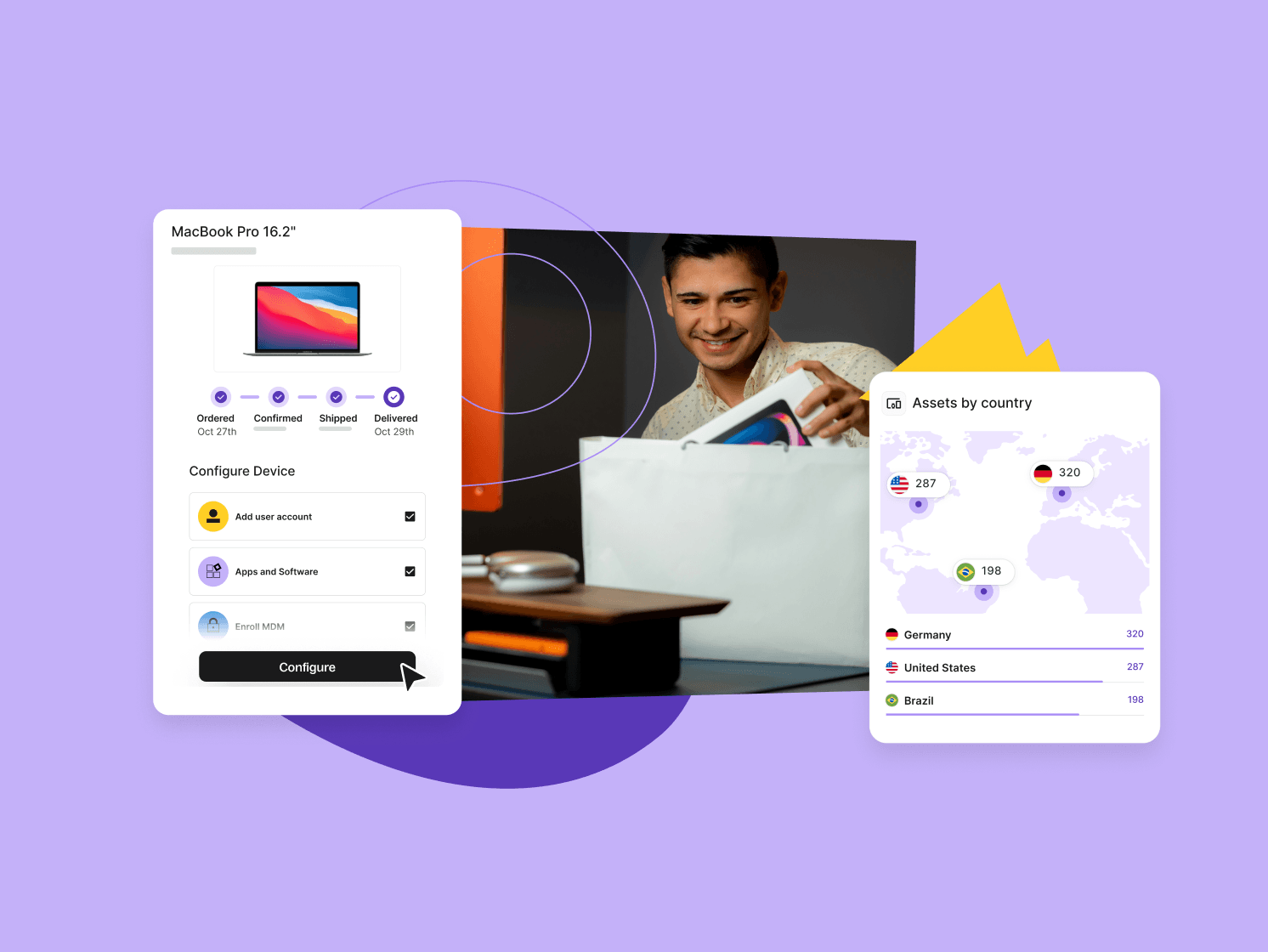
- Deel IT strengthens authentication through secure device foundations: devices arrive globally with MDM enrollment, security software, and proper encryption already configured, enabling authentication systems to verify device security posture and make smarter access decisions across distributed workforces.
| Outcomes |
How effective is IT equipment management in supporting it |
| Smooth onboarding experience |
• Devices arrive on time, fully configured for each employee
• No IT delays, ensuring employees are productive from day one
• Security and compliance handled before shipping
|
| Time and workload reduction |
• One partner manages sourcing, setup, and shipping
• Automated tracking of devices across locations
• Offboarding and device retrieval handled seamlessly
|
| Consistent global operations |
• Same process for every location
• Compliance managed across 130+ countries
• Local shipping speeds with centralized oversight
|
| Security and risk management |
• Devices pre-configured with MDM and company policies
• End-to-end visibility into device status
• Data protected across the full lifecycle
|
| Employee experience and retention |
• Reliable, secure tools signal trust and preparedness
• Fewer technical issues boost satisfaction and productivity
• HR teams can focus on people, not IT tasks
|
| Outcomes |
How effective is IT equipment management in supporting it |
| Smooth onboarding experience |
• Devices arrive on time, fully configured for each employee
• No IT delays, ensuring employees are productive from day one
• Security and compliance handled before shipping
|
| Time and workload reduction |
• One partner manages sourcing, setup, and shipping
• Automated tracking of devices across locations
• Offboarding and device retrieval handled seamlessly
|
| Consistent global operations |
• Same process for every location
• Compliance managed across 130+ countries
• Local shipping speeds with centralized oversight
|
| Security and risk management |
• Devices pre-configured with MDM and company policies
• End-to-end visibility into device status
• Data protected across the full lifecycle
|
| Employee experience and retention |
• Reliable, secure tools signal trust and preparedness
• Fewer technical issues boost satisfaction and productivity
• HR teams can focus on people, not IT tasks
|
The $4 billion investment around IBM Watson for Oncology is a cautionary tale. Despite partnerships with top institutions such as Memorial Sloan Kettering, Watson failed to meet clinical guideline expectations and was unable to revolutionize cancer care safely.
The root causes of today’s frequent AI failures include insufficient data quality, poor integration with clinical workflows, and unrealistic expectations about what AI can do. These failures underscore the need for data-first, governance-led AI strategies in healthcare.
HIMSS 2024 Survey reports:
- 86% of healthcare organizations now use AI (up from 53% in 2023)
- 64% of implemented AI projects show a positive ROI
- 60% of clinicians acknowledge AI’s diagnostic superiority in specific tasks
- Yet 72% cite data privacy as their biggest concern
(Source: HIMSS AI Survey 2024)
McKinsey’s 2024 Healthcare AI Outlook finds:
- 85% of healthcare leaders explore or adopt generative AI
- 61% lean on partnerships rather than in-house builds
- Administrative efficiency and clinical productivity lead to the highest success rates
(Source: McKinsey Healthcare AI Outlook 2024)
Healthcare AI operates inside one of the most heavily regulated industries, globally and in the GCC (ADGM, DIFC, SAMA, NCA). With the EU AI Act, effective Feb 2, 2025, and existing rules (HIPAA, GDPR, FDA), high-risk medical AI systems require risk management, technical documentation, and continuous monitoring.
Non-compliance can incur severe penalties, including fines up to 6% of annual turnover under EU rules. This practice leads to a dedicated AI compliance program and a multidisciplinary governance committee that covers legal, clinical, IT, and risk departments, as essential.
So, the most effective strategy is to implement policies for AI procurement, deployment, monitoring, and regulatory alignment as core program pillars.
AI is only as good as the data feeding it. Healthcare data is often fragmented across EHRs, labs, imaging systems, and legacy databases, causing inaccuracies and inconsistency.
Poor data quality undermines interoperability and poses a risk to clinical harm when models make decisions based on corrupted inputs.
Fixes include automated data quality monitoring, clear data ownership, and dedicating a significant portion of year-one AI budgets to data infrastructure and cleaning pipelines.
Without clean, accessible data, even the most advanced AI models can produce inaccurate and potentially dangerous misinterpretations that compromise patient safety.
Many healthcare providers face siloed platforms, non-standard formats, legacy architectures, and uneven implementations of HL7/FHIR standards. Even “FHIR-compliant” systems differ in vendor implementations.
Well, integration is not instant. You can expect 6-12 months per major system to integrate properly. So the actionable steps involve:
- Conducting an integration maturity audit before introducing AI
- Prioritizing vendors with proven interoperability track records
- Planning phased rollouts as per the major system
Even FHIR-compliant systems can differ in how they handle interoperability — so vendor due diligence is essential.
Technology succeeds only when people adopt it. Generic AI training rarely works in clinical settings. This results in most AI training programs failing. Do you know why? It’s because:
- They’re very theoretical and ignore clinical realities
- There’s no hands-on training with actual patient data or use cases
- They’re lacking AI-physician champions to drive peer learning
Now let’s see how to fix these concerns. The highest-adoption organizations create AI ambassadors, clinicians who become power users and train peers via peer-to-peer learning, simulation labs, and case-based practice.
Training should include simulation-based clinical scenarios, hands-on practice with de-identified patient records, and modules on compliance and ethics.
Healthcare data breach costs average $9.77 million per incident (IBM 2024). And that’s the world’s highest data breach costs across industries.
(Source: IBM Cost of a Data Breach Report 2024)
AI models can inadvertently reproduce identifiable patient artifacts, raising HIPAA/GDRR risks. And this makes security practices essential, which mainly include:
- Zero-trust architectures
- Air-gapped or sandboxed training
- Strong identity controls
- Encryption at rest and in transit
- Differential privacy or other privacy-preserving techniques for model training to prevent data leakage
Thus, balancing innovation and compliance seems key to sustainable patient care. It’s all about how comprehensively clinics adopt and integrate AI systems.
If AI models are trained on non-representative data, rather than diverse datasets, they can unintentionally magnify several healthcare disparities. This scenario may give worse outcomes, like unequal treatment to certain groups, favoring certain demographics, not all.
Ethical mitigation requires:
- Training AI models on diverse and representative healthcare datasets reflecting gender, ethnicity, age, and regional variations for fair and accurate patient outcomes
- Validating model performance and accuracy across different population groups to confirm diagnostic reliability and minimize disparities in care
- Conducting regular algorithm audits to identify bias, data drift, and ethical risks while maintaining fairness, transparency, and accountability in AI-driven healthcare decisions
- Setting up ethical AI review boards that include clinicians, ethicists, and community representatives to assess potential risks in AI systems before rollout, and monitoring how these systems perform in the real-world clinical setup
- Building multidisciplinary and diverse AI teams familiar with local medical, cultural, and linguistic contexts across the UAE and GCC
- Monitoring AI systems continuously and reporting frameworks to detect, document, and correct emerging bias in live AI systems, reinforcing compliance and trust in healthcare AI
By embedding these practices, healthcare providers in the UAE, Saudi Arabia, and across the GCC can build AI systems that are not only accurate but also equitable, transparent, and trustworthy, supporting better care for every patient.
AI should augment clinical judgement, not replace it. Design must align tightly with real-world decision flow. But for this, you must:
- Understand how AI fits into existing clinical decision-making processes
- Start with small pilot programs in controlled environments
- Ensure that AI recommendations enhance rather than replace clinical judgement
- Design intuitive UI/UX interfaces that integrate naturally with healthcare provider workflows
- Continuously validate AI outputs against clinical outcomes
- Update models or data pipelines accordingly
That’s why healthcare providers must maintain human oversight for all AI recommendations, with qualified and skilled professionals who better understand models’ capabilities and limitations. Successful implementation depends on seamless workflow fit, not just algorithmic accuracy.
Frequently asked questions
.svg)